Property type: Office
Office Property Bridging Loans Manchester
We arrange bridging finance against office property across Spinningfields (M3), the NOMA quarter (M4), MediaCityUK in Salford Quays, the Oxford Road university belt, Piccadilly, and the secondary office stock running through Stockport, Altrincham and Trafford. Loan sizes run £200,000 to £15 million, terms from 1 to 24 months, with completions in 7 to 21 days. Most office bridges price between 0.75% and 1.35% per month depending on covenant, vacancy and the credibility of the exit. The book skews toward repositioning, refurbishment and change-of-use rather than vanilla investment hold.
- Decisions in hours
- Completion in days
- £100k to £25m
- Greater Manchester specialists
The asset class
What office property looks like in Greater Manchester.
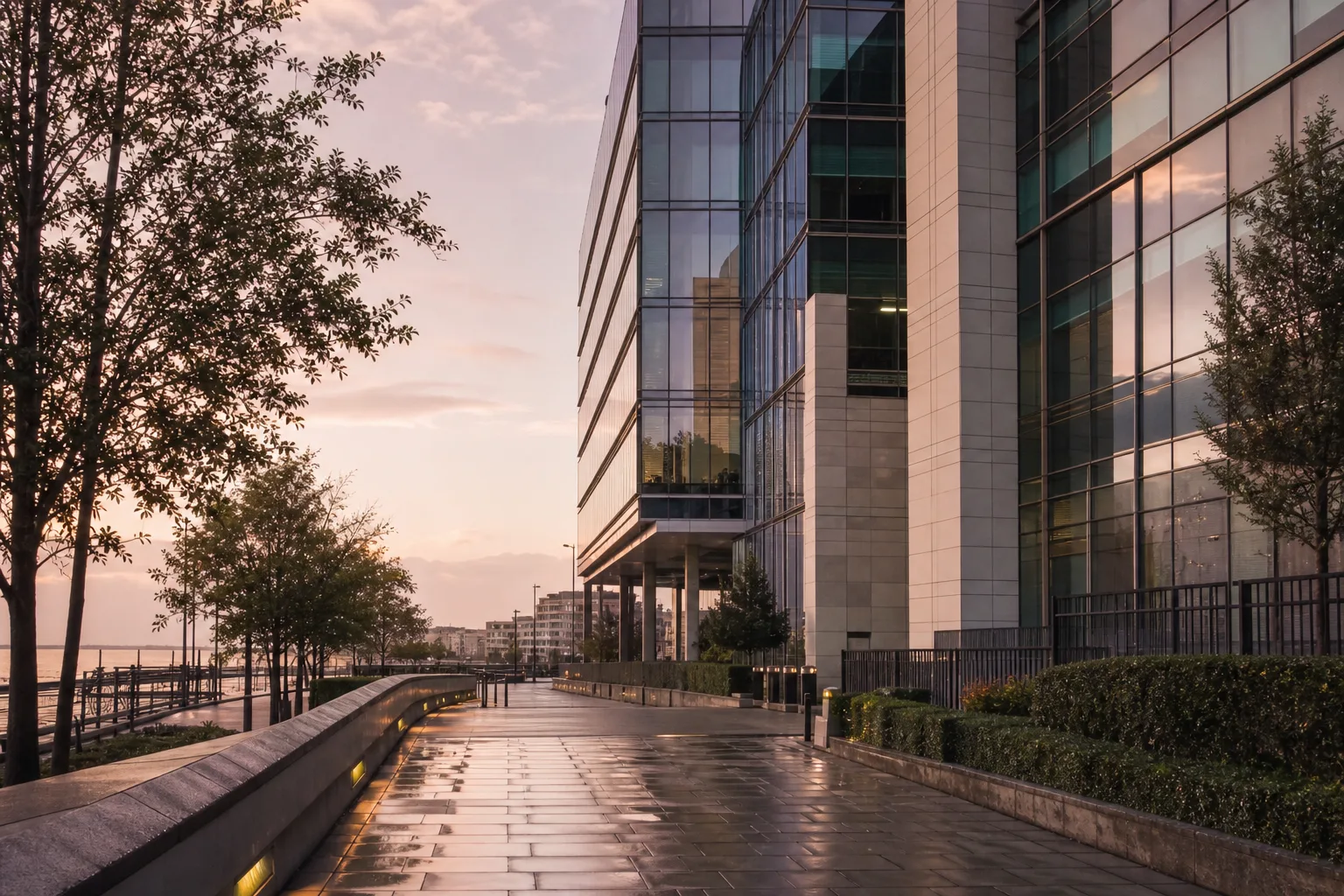
Office stock in Manchester and Greater Manchester ranges from Grade A floors in Spinningfields, NOMA and around Piccadilly station, through to secondary 1960s and 1970s blocks along Portland Street and Whitworth Street, through to converted Victorian warehouses across the Northern Quarter, Castlefield and Ancoats, and out to the secondary office stock in the Stockport, Altrincham and Trafford town-centre fringe. The market is bifurcated. Well-located, well-specced floors in Spinningfields, NOMA, the Circle Square scheme on Oxford Road and around the No.1 St Peter's Square cluster let well, often to legal, financial-services, professional-services and tech occupiers. Secondary blocks have struggled with hybrid working and many are candidates for residential, hotel or aparthotel conversion under permitted development or full planning. Each of those positions reads differently to a bridging lender and the underwriting follows.
Use cases
Bridging use cases for office assets.
Office bridging in this market clusters around six use cases. The first is repositioning of secondary stock, where a buyer takes a half-empty 1970s block, refurbishes the common parts and the floors, and re-lets at a higher tone. The second is change-of-use to residential under permitted development, which has driven a large share of the office bridging book across Manchester and Salford over the last seven years. The third is purchase of single-let investments with short unexpired terms, where the buyer expects either a re-gear or a vacant possession play. The fourth is development-exit where an office-to-resi conversion has reached practical completion and the units are marketing; bridging refinances the development facility while the sales close out. The fifth is capital raise against a low-LTV owner-occupied office, often by a professional-services firm, marketing agency or tech business wanting to fund the next deposit or works elsewhere. The sixth is auction purchase of small office buildings, typically below £1 million, where the 28-day clock and the vacant possession risk push the deal into bridging rather than term debt. Across all six, lenders look for a clear exit and a buyer who has done it before.
Manchester context
The Manchester Office Market: Spinningfields, NOMA, MediaCityUK and the Secondary Town-Centre Stock
The Manchester office market is the largest regional office market in England outside London. Spinningfields, the post-2000 estate west of Deansgate in the M3 postcode, sits at the heart of the legal-and-finance cluster, with HSBC, RBS, Deloitte, PwC, KPMG, EY, DLA Piper, Pinsent Masons and Eversheds Sutherland all anchored within a half-mile radius. Average prime rents in Spinningfields run materially above the wider Manchester average, and the Grade A floor pipeline at No.1 Spinningfields, Landmark and the wider XYZ-and-2 New Bailey extension into Salford supports a deep institutional letting market. NOMA, the regeneration quarter centred on Dantzic Street and the former Co-operative Group estate in M4, has become the city's tech-and-creative office cluster, anchored by the Hanover and Federation buildings and by Amazon, Microsoft and the BBC's North West functions in the wider M4 catchment. MediaCityUK in Salford Quays holds the BBC's northern HQ, ITV Studios and Coronation Street, dock10 post-production, the University of Salford's MediaCityUK campus, and around 250 creative and digital businesses across the Tomorrow, Orange Tower and Quay House buildings. The Oxford Road corridor links the M1 city centre south through the universities to the Circle Square mixed-use development. Secondary office stock across Stockport town centre (centred on the Stockport Exchange and Interchange schemes), Altrincham (where the Stamford Quarter and town-centre office floors have absorbed back-office and professional-services demand off the back of the Metrolink and the John Lewis-anchored regeneration), and the Trafford fringe (including the Trafford Park office stock and Old Trafford industrial fringe), gives the wider Greater Manchester market depth. For a bridging case the relevant point is that office demand in Manchester is driven by legal, finance, professional services, broadcast media and tech, with hybrid working hitting the secondary stock hardest. BN-style speculative life sciences demand has its parallel here in the science-led campuses around the Manchester Science Park (M15) and the Health Innovation Manchester pipeline. Lenders who understand this price the asset correctly. M3 holds the prime financial cluster, M4 holds the tech-and-creative cluster, Salford M50 holds MediaCityUK, and the suburban Stockport, Altrincham and Trafford stock holds the conversion-and-reposition pipeline.
Valuation and lenders
Valuation and lender considerations.
Office valuations come back on yield-and-rent for income-producing assets, vacant possession for empty floors, and residual or GDV for conversion plays. Bridging lenders generally lend on the lower of the relevant figures. LTV caps sit at 60 to 65% on vacant secondary office, 65 to 70% on tenanted investments with a recognisable covenant, and 60 to 65% on as-is value where the case is a conversion play with day-one drawdown plus a refurbishment tranche. MT Finance, Octane Capital, United Trust Bank, Hope Capital and Together all run office bridging, with Avamore Capital, ASK Partners, OakNorth and Shawbrook stronger at the larger end. Lenders care about planning position, covenant strength and the realism of the exit. Vague exits kill office cases harder than any other asset class.
What we arrange
What we typically arrange.
A typical Manchester office bridge sits at £500,000 to £4 million, 60 to 70% LTV, 9 to 15 months term, 0.75 to 1.25% per month, arrangement fee 1.5 to 2%. We package the planning position, the covenant evidence and the exit plan up front so the lender sees the case the way the underwriter needs to see it. Conversion cases include a monitored works tranche; investment-purchase cases focus on the lease and the refinance route. Completion in 14 to 21 days is normal where the title and planning are clean. Where there is a contested planning position, the underwriting takes longer and the rate moves up.
FAQs
Office bridging questions
Can we bridge an office to residential conversion in Manchester?
+
Yes. Office-to-residential conversions under Class MA permitted development and under full planning have been a steady part of the Manchester bridging book since 2017. We arrange the day-one purchase tranche against the as-is office value, a works tranche released against monitoring sign-off, and exit to BTL refinance for held units or open-market sale for disposals. Article 4 directions apply in parts of the city, so we check the planning position before going to lender, and we work with planning consultants who know the Manchester City Council and Salford City Council positions on these conversions.
Does prime Spinningfields office stock bridge differently to secondary Portland Street stock?
+
Yes. Prime Spinningfields and NOMA office buildings, where lettings are to recognisable legal-and-finance or tech covenants on long leases, price at the lower end of the bridging range and lenders will go to 65 to 70% LTV against investment value. Secondary 1970s Portland Street, Whitworth Street and Princess Street stock, where vacancy is higher and tenant covenants are weaker, sits at the upper end of the range with 60 to 65% LTV caps and more questions on the refurbishment or repositioning plan. The MediaCityUK stock sits between the two and reads on the BBC and ITV anchor tenancies plus the surrounding creative-cluster demand.
How long does an office bridge complete in Greater Manchester?
+
Standard completion is 14 to 21 working days from instruction. Office valuations on multi-floor or part-let buildings can run longer than residential, with 7 to 10 working days for the valuation report alone on a complex case. Where the title is clean, the planning position is settled and the covenant evidence is clear, we have completed office bridges in 12 working days. Where planning is contested or the building has structural complexity, expect closer to 28 working days.
Tell us about the deal
Indicative terms within 24 hours.
A short triage call, then a sized indicative offer against a named lender for your office property in Manchester or across Greater Manchester.
Regulated bridging on owner-occupied residential property falls under FCA regulation. Unregulated bridging on commercial and investment property does not. We are not directly regulated by the Financial Conduct Authority, and we introduce regulated cases to authorised partners who carry out the regulated activity.
Next step
Talk to a Manchester office bridging specialist.
We arrange short-term finance on office property across Manchester, the Brighton and Hove unitary authority and the wider Greater Manchester market. Indicative terms in 24 hours.